[[from an email to corax. posted by permission.]]
I've read dogma_i's post on "Container materials for tea storage" several times now, and I admire the rather full treatment of the subject in one wrapper, so to speak. Besides having much to impart, it also rekindles an idea I've had floating in my head for a little over a year now.
First, some background: I live in the center of the nation's biggest tree fruit ag region. Growers try to stretch their harvest period by planting at various altitudes, but still the harvest period for each fruit (cherries, apricots, plums, peaches, nectarines, and apples) is rather short, and that is not good for fruit prices. Therefore, quite a bit of research has been carried out in controlled atmosphere (CA) storage. In my little town are mammoth CA warehouses. Big corporations and cooperatives store fruit -- especially apples -- in giant vaults from which normal air has been flushed, and in its place they've pumped in what I'm guessing is nitrogen and other gasses. At the same time they lower the temperature to just above freezing. This has the effect of prolonging the fruit's shelf-life. What they do not want in their CA warehouses is oxygen: it makes the fruit age.
More background: About twenty-one percent of our atmosphere is comprised of oxygen. What is accelerated decay to warehoused produce may be life itself to the ailing human body: Hyperbaric oxygen therapy places patients in an environment of pure oxygen under several times the normal atmospheric pressure, pressure much like conditions encountered by divers and by deep-sea explorers in bathyspheres and bathyscaphes. Indeed, some hospitals employ these very undersea vessels in their therapy units. Although the vessels are securely bolted to the floor and not lowered under water, therapists actually refer to the hyperbaric oxygen sessions as "dives."
More background still: Besides those victims of the "bends" who make use of a hyperbaric environment for alleviation of their painful condition, patients suffering from a variety of health problems -- including diabetes, carbon-dioxide poisoning, and radiation damage -- find that hyperbaric oxygen therapy is often conducive to healing damaged tissue that might otherwise not heal, by allowing oxygenated blood to travel to damaged areas. The increased atmospheric pressure of the hyperbaric chamber, as I understand the process, breaks the oxygen into smaller particles, allowing the richer blood to travel to -- and help to regenerate -- damaged capillaries. Eight summers ago I myself underwent extensive hyperbaric oxygen treatment at Seattle's Virginia Mason medical center. The equipment at Virginia Mason is quite complex, much of it operated by Navy SEALs and doctors outside of the bathysphere and medical staff within the bathysphere. Each day I spent about two hours in a pressurized chamber, breathing pure, pressurized oxygen, in an attempt to stimulate the regeneration of capillaries in my jaw. The treatment, I'm happy to report, was a success.
Now to tea: To my knowledge, the aging of pu'er entails several factors, including temperature, humidity, fermentation, enzyme activity, and oxidation. I haven't a clue as to which of these plays the biggest role. But I do know this: If I were a pu'er-collecting medical doctor working in the Virginia Mason Hyperbaric Department, I would absolutely run an experiment to explore the effect of hyperbaric oxygen on changes in pu'er. I'd use four beeng chas -- same production, same vintage. I'd flake up two of them. I'd keep one compressed beeng cha and one flaked beeng cha in the hyperbaric oxygen chamber and the other flaked and compressed beeng chas in a "normal" aging environment. At the end of some pre-determined treatment period (a month?), I'd compare the hyperbaric beeng chas with the non-hyperbaric beeng chas. (Sadly, I cannot undertake that experiment.)
Regarding the finer points of science and technology, I don't know very much at all. However, some readers of CHA DAO may. It occurs to me that one need not have at his or her command a big, hospital-style bathysphere with crews of medical and technical specialists to monitor it. A hyperbaric chamber need not have room to seat five patients and three PA's. A tank no bigger than a stovetop pressure cooker would suffice. I know that hyperbaric oxygen delivered for short periods over a span of weeks is more salubrious for most medical purposes (excepting bends) than one long, hyperbaric oxygen session.
The procedure for subjecting pu'er to hyperbaric oxygen might be somewhat complex. As an ex-homebrewer of the most ardent sort, I initially considered the simple step of placing some pu'er in a small soda canister or beer keg and pressurizing it with oxygen obtained at a welding-supply store. But then I recalled that my own time as a hyperbaric oxygen patient was not that straightforward. In each hyperbaric session, the chamber was pressurized to the equivalent of eighty feet below sea-level, and then we breathed pure and pressurized oxygen supplied in a steady flow via oxygen hoods that we wore over our heads. I suppose, therefore, that oxygen flow is an important part of hyperbaric oxygen treatment, and I cannot conceive of a method whereby a home-based researcher could recreate those conditions on a small scale without a very big investment in time, energy, and money. A device whereby oxygen can be held pressurized in a tank is rather easy to visualize, but a pressurized device with flowing oxygen inside it is somewhat more challenging to one, like me, with few technical and scientific skills. I'm certain, however, that somebody with more expertise and creativity can invent an elegant and parsimonious apparatus and procedure.
I'm not asserting categorically that hyperbaric oxygen will radically speed up the aging of pu'er, but wouldn't it be really, really cool if it did?
Monday, July 31, 2006


Monday, July 24, 2006
corax notes for the tea-disc summer wuyi yan cha tasting

here, late but in earnest, are my tasting notes for the summer 2006 wuyi rock teas generously supplied by blake ross. as the identities of each are now widely known, i will include the listings along with my remarks here, though it should be noted that i did not keep an eye on them as i was making my notes during the tasting itself -- just as i also did not look at others' tasting notes while i was writing my own. [i did consult and think about the ID list, as well as some of the other tasters' notes, as i reflected afterward on the entire procedure.] my notes on each -- before and after the brewing process -- are detailed below, and followed at the end by some general comments.
[A] Taiwan Shui Xian [www.shanshuiteas.com]
dry leaf appearance: green, fisted. looks like a taiwan oolong, maybe 45-50% oxidation.
dry leaf aroma: virtually nil


infused leaf appearance: very uniformly dark green in color. some surprisingly large leaves amongst the unfurled. as expected, some stems.
infused leaf aroma: pungent vegetal/tea scent
liquor appearance: dull medium gold, very little ruddiness to it.

liquor aroma: some of that characteristic 'wuyi' type of scent to it, but much 'greener' than the typical wuyi tea.
taste: more vegetal than the average mainland shuixian, reflecting perhaps its less-baked nature. there are some floral notes that almost hark to the baozhong here. the finish is fairly dry but not terribly 'puckery'; a touch of acidity in the aftertaste.
[B] Organic Wu Yi [www.rishi-tea.com]
dry leaf appearance: very dark green -- so dark as to be almost black -- twisted leaf with some breakage [probably during shipping] -- pieces almost small enough to be counted 'fannings.' as you will see from the photograph, the smallest of these made their way into the bottom of the cup, even through the mesh of a medium-fine strainer.
dry leaf aroma: a surprisingly fresh scent for leaf so dark. but very faint.

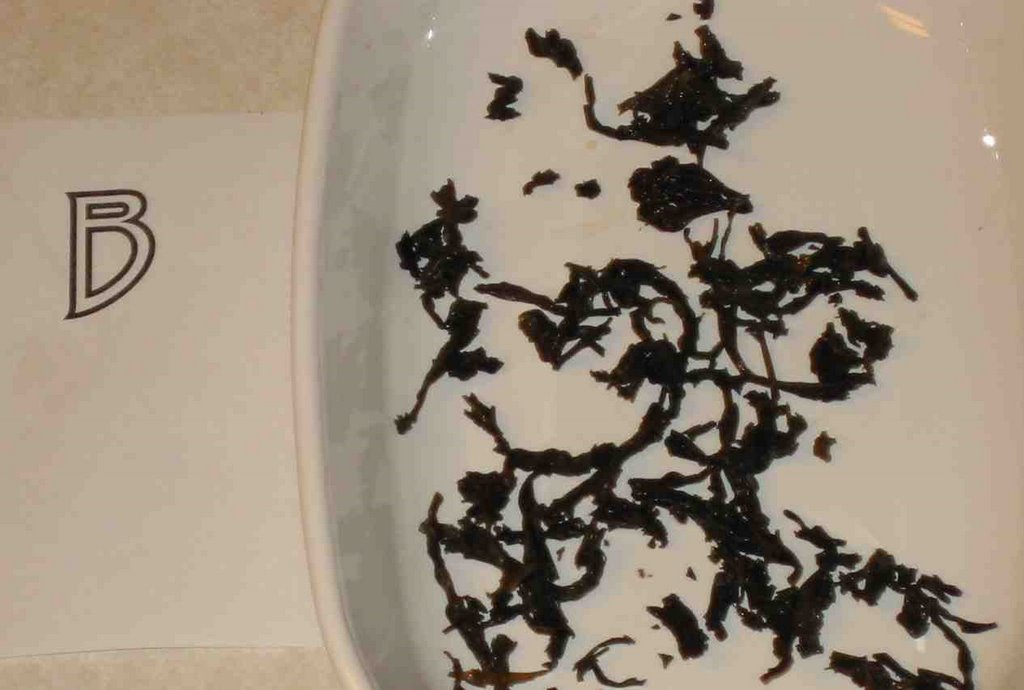
infused leaf appearance: dark olive-green, somewhat scrappy, not entirely unfurled by a first infusion.
infused leaf aroma: first sniff, nutty, yielding in a second or two to more vegetal.
liquor appearance: pale copper, ringed with a green hue around the wall of the cup.

liquor aroma: a 'clean' scent, which i find often correlates to a certain astringency on the palate.
taste: this tea quickly offers a spectrum of tastes from what i think of as 'high' [light or subtle floral] to 'low' [nutty], the latter resonating with what one finds in some shuixian teas. it is not as astringent as one might have expected. the aftertaste tends a bit to the metallic.
[C] Da Hong Pao [www.teaspring.com]
dry leaf appearance: very substantial leaf size, fairly lightly twisted such that each leaf's width is still suggested. dark green.
dry leaf aroma: just a hint of earth or must at the opening -- instantly morphing [even as one sniffs] to a fresh tea scent [but a more generic aroma than what i think of as the distinctive 'oolong' scent panel]


infused leaf appearance: collard-green colored, beginning to unfurl.
infused leaf aroma: a brief hint of floral, giving way almost immediately to a light vegetal.
liquor appearance: medium [dull] gold.

liquor aroma: very faint, very subtle, almost entirely floral.
taste: my first inclination was to say 'restrained,' but as i continue to sip on this tea i am inclined to say, rather, 'faint' -- as if the tea were stale or not of a premium grade. what taste is there is good, and suggests a distinguished pedigree somewhere along the way. little astringency, but also a negligible finish.
[D] Traditional Da Hong Pao [www.teaspring.com]
dry leaf appearance: this looks to be a heavily oxidized tea. almost no green leavening the brown color. large leaf size, perhaps even wider than [and at least as lightly twisted as] 'C.'
dry leaf aroma: almost like hongcha, again underscoring the high oxidation level of this tea.


infused leaf appearance: very dull dark green, some leaves fully unfurled within the first infusion.
infused leaf aroma: nutty, inviting.
liquor appearance: not especially dark or deep in color, but more ruddy in hue than that of 'C.'

liquor aroma: this liquor fairly instantly sings 'da! hong! pao!' -- it would be hard to miss that aroma.
taste: not as sweet as the aroma of the liquor had led me to expect, but a fairly satisfying [if undistinguished] brew. the floral notes assert themselves first, leaving the nutty for the middle and finish. not especially astringent, but with a tenacious aftertaste.
[E] Imperial Rou Gui [www.sevencups.com]
dry leaf appearance: twisted leaf, somewhat more tightly twisted than 'C' or 'D,' perhaps about as oxidized as 'C.' i expect the leaf on the bush was somewhat smaller than either of those.
dry leaf aroma: virtually nil


infused leaf appearance: dark green, fairly well unfurled for a first infusion
infused leaf aroma: almost entirely vegetal
liquor appearance: deep buttercup gold

liquor aroma: very faint, almost undetectable
taste: surprisingly bitter; neither particularly floral nor especially nutty. medium astringency and a fairly quick finish.
[F] Tie Luo Han [www.imperialtea.com]
dry leaf appearance: another fairly-highly-oxidized tea here, leaves of various sizes fairly well rolled.
dry leaf aroma: another faint fresh 'tea' scent, but again not especially oolongy as i perceive it.


infused leaf appearance: some cut leaf in this batch; deep forest-green notes among streaks of brown.
infused leaf aroma: quite floral overall
liquor appearance: medium gold with a russet tone to it

liquor aroma: not surprisingly, somewhat [faintly] floral
taste: the floral aspects of the taste are quite distinct on certain parts of the tongue, but vanish [characteristically] fairly quickly. the lower notes of the taste -- not quite 'nutty' in this case, but somewhat between that and the vegetal -- step forward next. only in the long finish does some astringency appear, along with [interestingly] a tiny sour note.
GENERAL COMMENTS AND REFLECTIONS:
the parameters i used for all six teas were as follows: 4 grams of leaf, 4 oz of water [heated to 'fish eyes' boiling], infused in a porcelain cebei for 30 seconds [just slightly longer than the traditional 'three breaths' duration]. decanted into porcelain tasting cups. most of these teas could have gone for several infusions, but i decided for the purposes of these notes to write about a single infusion of each.
i thought hard, to begin with, about brewing parameters, both in deference to blake's generosity and just because this was not a light undertaking: it deserved careful consideration, just as the other tasters gave it. in the end i decided against the professional taster's method, because i wanted [as it were] the best of both worlds: to set up, on one hand, a fairly strict and uniform preparation- and tasting-environment, so as to level the playing-field as much as possible, and also to observe how the teas would perform in a 'normal' home environment -- which is, after all, the way almost all of us prepare and drink our teas.
as kevin 凱聞 astutely noted and mentioned in his blog, 'A' is not a true wuyi tea, but rather a taiwan shuixian. as the shuixian varietal apparently originated in the wuyi area, however, i decided to include 'A' in my tasting notes. i brewed and tasted it last of the six, by way of foil or contrast to the five mainland teas supplied.
i gathered my data [as detailed above] in one longish session. later the same day, but while the entire cumulative experience was still fresh in my mind, i began to ponder the sum total of my results. returning to the originary questions that blake posted to tea-disc:
> What qualities are we looking for?
> What are the standards for good Wuyi tea.
i saw that these queries go to the heart of the whole tea-tasting enterprise, but are not identical in their focus. nor are they likely to elicit uniform answers from all tea-drinkers. first off, of course, not all tea-drinkers will be looking for the qualities that tend to characterize wuyi yan cha. so their answer to the first question will obviously be 'not the qualities these teas have to offer, thanks!' setting that reaction aside, however, the question of standards for wuyi teas remains. is there a set of standards that will apply to all wuyi yan cha? perhaps not, although there tends to be a certain uniformity to the appearance of the dry leaf, a certain portion of the color-spectrum to which the brewed liquor tends to adhere, and a certain readily-identifiable taste [or rather, complex of tastes -- for wuyi yan cha is nothing if not complex in the tasting, from the beginning of the sip to the end of the aftertaste] to the brewed liquor.
blake's questions intimate the desire or quest for a canon -- a 'measuring-stick' or standard of quality by which we can gauge each wuyi tea. once again, we come to this quest somewhat late in the enterprise, as the chinese themselves have been at it for hundreds of years already. indeed some traditions trace the origin of oolong teas precisely to the wuyi area of fujian. of such teas, the traditional 'four famous wuyi yan cha' are da hong pao ['big red robe'], tie luo han ['iron warrior monk'], bai ji guan ['white cockscomb'], and shui jin gui ['golden water turtle']. and of these four, we included only the first two in our tasting. so right off the front end, we have departed from traditional canons. there is nothing intrinsically wrong with that approach, but we should recognize how we are proceeding. there is no inherent reason that shuixian or rou gui, for example, might not rise to the top of our own personal canons of wuyi excellence. but such a revisionist position ought to be arrived at only after long and very broad exploration of the field.
the inclusion of one 'formosa' oolong here -- the shuixian -- reminds us, first and foremost, of the unimaginably vast variety of what we may call 'china teas' [including, without political implications either way, those from taiwan]. it causes us to remember, moreover, that not all shuixians are from the mainland; that, of mainland shuixians, not all are from fujian; and that, of fujian shuixians, not all are from wuyi shan. similar complexities obtain for each and every other oolong, and probably for most china teas across the board. blake's questions -- disarmingly simple to begin with -- become more and more complex themselves, in view of all this.
all our on-list discussions, beforehand, of whether/how to standardize our preparations and tasting procedures, themselves served to highlight the inherent variability and mutability of all such human enterprises. some of the variables, in the larger scheme of things, include:
** type of tea
** specific varietal of this type
** the specific harvest from which this leaf comes
** the specific lot of a given harvest from which this leaf comes
** storage and shipping procedures
** shelf-age of the tea leaves
** type of water used
** brewing parameters: timing, proportions, equipage
and of course none of this begins to account for the incalculable variation from one palate to another, and how differently even the same palate may react or perform on different days, depending on health, energy, thirst, hunger, stressors, etc.
despite this ever-turning kaleidoscope of variables, we somehow seem to manage to produce and discern our individual likes, dislikes, and preferences. those preferences tend to be reliable enough for us to be able to walk into a tea-shop [or browse a website] and say, 'ah, i want some of this tea,' or 'erm, i don't so much like that one.' [and, too, it's the illusion of stability in the material world, in our sensory manifold, and in our aesthetic responses, that tends to flummox us when we order a beloved tea months later, only to find that it's not nearly as good as what we remembered.] because not every vendor's tie luo han is identical, and because probably not even the 'same' tie luo han -- i.e. tea made similarly from the selfsame bushes, from one year to the next -- is always going to taste the same, we afford ourselves the fun of shopping around, trying new sources, crowing or quibbling over old ones. and because the cha dao is a long, winding road -- one that we eventually come to see stretches across our entire lifetime -- the gradual accumulation of age and experience tends to shape and affect our tastes themselves. our very preferences, sometimes so strong that we almost feel they sketch the contours of our personality, are not as granitic as we might like to pretend. over time, the tea itself teaches us, and changes us.
we could have done our tasting in a number of other ways. for instance, we could have chosen just one wuyi yan cha, say da hong pao, and obtained that from six different vendors. or we could have chosen the 'four famous yan cha,' plus four that are not on that list, and tried to see whether the 'famous' teas in fact deserve their lofty reputations. or we could have assembled several tasters in one location, and had a skilled tea-brewer prepare the tasting for all of them at once, so that they could experience [blindfolded or not, as we pleased] the very same brew, out of the same sharing pitcher [thus eliminating several of the principal variables listed above]. but i am content, even delighted, with the way we have undertaken this very tasting. it offered some challenges and some potential surprises and some actual delights. the focus entailed in this exercise ensures, i'm betting, that none of us will look at yan cha in quite the same way again.
Saturday, July 15, 2006
Once Upon a Time...Anodyne on SpecialTeas Royal Golden Yunnan
Once upon a time...a long time ago...
...I was consistently drinking http://www.specialteas.com/ #509 Royal Golden Yunnan. It was a favorite until, at some point, it ceased to live up to past lots. I meandered down the path to In Pursuit of Tea's Royal Yunnan which kept my attention through 2005 until it, too, veered from previous performance in January of 2006. As of March 2006, it was still not back in old form. And so I had meandered back to Silk Road Teas Yunnan Gold High Grade which has been a mercurial experience over the years--at times quite good, other times not as good as the price warranted. Currently, it's drinking more in the style of IPOT's 2005 Royal Yunnan, with that "Woodwosian" fruity-woody profile, a different profile from other Yunnan teas that I have come across. It's a rustic sort of Yunnan experience that just says "dark forest" to me.
A fellow Yunnan lover recently posted (on a tea list) about his current experience with SpecialTeas #509 Royal Golden Yunnan, and so I meandered back for two ounces of this tea to test the mocha waters. Yunnan is a favorite tea of mine that I follow like the crocodile followed Captain Hook from "sea to sea, land to land." I confess to being rather fickle when it comes to my Yunnan. I'll say good-bye rather quickly to one vendor's source if another vendor has one that I prefer.
The current lot of #509 is not in the ballpark of my favorite IPOT "Woodwose" Yunnan, but it is performing rather decently at less cost than some. It has a very aromatic profile, one that focuses on those maple-y notes. The aroma profile is in that mocha range. The maple sweetness meanders into the cup against the controlled earth notes. Light cocoa. This isn't an aggressive smoky or leathery Yunnan, nor is it in the savory or highly malty category. Not as complex as some I've had in times past, but the balance of maple/earth is pleasing. There's even a light floral note finds its way into the finish. This is less pricey than the aforementioned Silk Road Teas Yunnan Gold High Grade, and I can see myself gravitating toward this #509 as a daily drinking type Yunnan.
I don't expect to live happily ever after with any vendor's golden Yunnan. This is, as previously noted, a quest that winds ever on and on.
...I was consistently drinking http://www.specialteas.com/ #509 Royal Golden Yunnan. It was a favorite until, at some point, it ceased to live up to past lots. I meandered down the path to In Pursuit of Tea's Royal Yunnan which kept my attention through 2005 until it, too, veered from previous performance in January of 2006. As of March 2006, it was still not back in old form. And so I had meandered back to Silk Road Teas Yunnan Gold High Grade which has been a mercurial experience over the years--at times quite good, other times not as good as the price warranted. Currently, it's drinking more in the style of IPOT's 2005 Royal Yunnan, with that "Woodwosian" fruity-woody profile, a different profile from other Yunnan teas that I have come across. It's a rustic sort of Yunnan experience that just says "dark forest" to me.
A fellow Yunnan lover recently posted (on a tea list) about his current experience with SpecialTeas #509 Royal Golden Yunnan, and so I meandered back for two ounces of this tea to test the mocha waters. Yunnan is a favorite tea of mine that I follow like the crocodile followed Captain Hook from "sea to sea, land to land." I confess to being rather fickle when it comes to my Yunnan. I'll say good-bye rather quickly to one vendor's source if another vendor has one that I prefer.
The current lot of #509 is not in the ballpark of my favorite IPOT "Woodwose" Yunnan, but it is performing rather decently at less cost than some. It has a very aromatic profile, one that focuses on those maple-y notes. The aroma profile is in that mocha range. The maple sweetness meanders into the cup against the controlled earth notes. Light cocoa. This isn't an aggressive smoky or leathery Yunnan, nor is it in the savory or highly malty category. Not as complex as some I've had in times past, but the balance of maple/earth is pleasing. There's even a light floral note finds its way into the finish. This is less pricey than the aforementioned Silk Road Teas Yunnan Gold High Grade, and I can see myself gravitating toward this #509 as a daily drinking type Yunnan.
I don't expect to live happily ever after with any vendor's golden Yunnan. This is, as previously noted, a quest that winds ever on and on.
Thursday, July 13, 2006
Geraldo: Notes Toward the Achievement of Prolonged Pleasure (with Pu’er)
Recently I had the happy opportunity of visiting good tea friends in New York City. Several of us came from far-flung locations to drink tea and tour the city. We drank high-rated Shincha just twelve days after it was harvested, very old liu an, aged green teas, oolongs, young shengs, aged shu, and tea of nearly every stripe. Two of them, in my mind, were especially notable—aged shengs nearly a century old.
Our group met officially twice—once at a pre-party at a New York City teashop, and again the next day at the home of one of our New York hosts. On each of those two occasions, we drank the century pu’ers, and we enjoyed many, many infusions from them. It was a once-in-a-lifetime opportunity for me to taste these rare treasures. After the second meeting, several of us met informally to tour the city, and our host had with him a portable tea set and a high-quality vacuum bottle. In the vacuum bottle, he had placed the so-called “spent leaves” of the aged shengs, and he had steeped them for eight hours or more in boiling water. We drank it on the Staten Island ferry as we cruised by the Statue of Liberty, and the tea was superb. We drank it again the next day after yet another eight-hour infusion, and again, it was fantastic.
I returned to my home in the Pacific Northwest determined to put to use what I had learned about overnight steeping of aged sheng pu’er. Generally I dip into my aged sheng collection about once a week, but in honor of my mother’s 80th birthday, last week we drank a different aged pu’er on four successive days: sublime liu bao received as a gift, Thirty Years Yun Lai (Clouds Arriving) #7542 from Sunsing, 70’s Grand Yellow Label from GrandTea, and 70’s #7532, also from GrandTea.
In each case, we used 4.5 grams of dry leaf, and we took, on the average, eighteen infusions from each. I decided to make a blend of three of these old pu’ers. I did not include the liu bao in the mix since it is different in nature, being a much darker, more fermented true black tea. I spread the so-called “spent leaves” of the other three aged pu’ers on dinner plates in my cupboard. They dried overnight.
I have a vacuum decanter that purportedly keeps beverages hot for twelve hours. It holds about thirty-four ounces (one liter). I placed the now-dried leaves of the three aged pu’ers in the pre-heated decanter and filled it with boiling water. Eight hours later, I tasted the results with my mom. The flavor and aroma were quite surprising; the tea was very lively and strong, almost too strong, but it was, nevertheless, delicious. From this experiment, Mom and I each were able to enjoy eight teacups of aged pu’er from leaves that in the past I would have discarded.
I dried the “spent leaves” yet again that night on dinner plates in the cupboard. The next day I repeated the vacuum pot brewing procedure. And again, after eight hours, when Mom and I tried the results, we were once more delighted with the outcome. The liquor was more subtle than the previous day’s, and the flavors were wonderfully nuanced with camphor, leaf mulch, and vanilla flavors.
In the next phase of this research, I shall make one change: I’ll use one-third less aged pu’er. The first batch of protracted-steeped pu’er was almost too strong. Instead of mixing the spent leaves from three sessions, I will employ the spent leaves from two.
Perhaps many readers of Cha Dao already were cognizant of this procedure for extracting everything possible from aged sheng. For me, however, it is an epiphany. Pu’er of this nature is not inexpensive, and I realized from early on that it is a marvelously generous beverage, but now I know a method by which I can prolong the pleasure obtained from every gram of this rare treasure that has captured such a central place in my imagination.
[[posted by corax at the request of Geraldo]]
Our group met officially twice—once at a pre-party at a New York City teashop, and again the next day at the home of one of our New York hosts. On each of those two occasions, we drank the century pu’ers, and we enjoyed many, many infusions from them. It was a once-in-a-lifetime opportunity for me to taste these rare treasures. After the second meeting, several of us met informally to tour the city, and our host had with him a portable tea set and a high-quality vacuum bottle. In the vacuum bottle, he had placed the so-called “spent leaves” of the aged shengs, and he had steeped them for eight hours or more in boiling water. We drank it on the Staten Island ferry as we cruised by the Statue of Liberty, and the tea was superb. We drank it again the next day after yet another eight-hour infusion, and again, it was fantastic.
I returned to my home in the Pacific Northwest determined to put to use what I had learned about overnight steeping of aged sheng pu’er. Generally I dip into my aged sheng collection about once a week, but in honor of my mother’s 80th birthday, last week we drank a different aged pu’er on four successive days: sublime liu bao received as a gift, Thirty Years Yun Lai (Clouds Arriving) #7542 from Sunsing, 70’s Grand Yellow Label from GrandTea, and 70’s #7532, also from GrandTea.
In each case, we used 4.5 grams of dry leaf, and we took, on the average, eighteen infusions from each. I decided to make a blend of three of these old pu’ers. I did not include the liu bao in the mix since it is different in nature, being a much darker, more fermented true black tea. I spread the so-called “spent leaves” of the other three aged pu’ers on dinner plates in my cupboard. They dried overnight.
I have a vacuum decanter that purportedly keeps beverages hot for twelve hours. It holds about thirty-four ounces (one liter). I placed the now-dried leaves of the three aged pu’ers in the pre-heated decanter and filled it with boiling water. Eight hours later, I tasted the results with my mom. The flavor and aroma were quite surprising; the tea was very lively and strong, almost too strong, but it was, nevertheless, delicious. From this experiment, Mom and I each were able to enjoy eight teacups of aged pu’er from leaves that in the past I would have discarded.
I dried the “spent leaves” yet again that night on dinner plates in the cupboard. The next day I repeated the vacuum pot brewing procedure. And again, after eight hours, when Mom and I tried the results, we were once more delighted with the outcome. The liquor was more subtle than the previous day’s, and the flavors were wonderfully nuanced with camphor, leaf mulch, and vanilla flavors.
In the next phase of this research, I shall make one change: I’ll use one-third less aged pu’er. The first batch of protracted-steeped pu’er was almost too strong. Instead of mixing the spent leaves from three sessions, I will employ the spent leaves from two.
Perhaps many readers of Cha Dao already were cognizant of this procedure for extracting everything possible from aged sheng. For me, however, it is an epiphany. Pu’er of this nature is not inexpensive, and I realized from early on that it is a marvelously generous beverage, but now I know a method by which I can prolong the pleasure obtained from every gram of this rare treasure that has captured such a central place in my imagination.
[[posted by corax at the request of Geraldo]]
Anodyne on Silk Road Teas Yunnan Gold High Grade
To further muddy the mocha'd Yunnan waters, I just received an order from Silk Road Teas which included more of their Yunnan Gold. I'd tasted this one in March 2006, and while I don't truly know if this July lot is different from that one, I immediately noted a sweet-woody scent in the bag after first opening it. That triggers the "Woodwose" memory, as this is what was unique to the In Pursuit of Tea Royal Yunnan back in 2005. It comes through while steeping, too, a sweet woody note against the earth and maple notes. Post-steeping, yes, it's still there--just a slightly different range of aroma than I find in most Yunnan golds and particularly not in the ones with youthful profile, though they sometimes have their own charms.
There is a hint of maple in this one, too, but it goes up against the sweet-woody (a less dramatic variation of the "Woodwose") and earth notes. This is my first casual drinking of this tea, so I have no full pronouncement. But this is the first time since the 2005 IPOT Yunnan that I've found this particular range of aroma/flavor at this particular level. Counting only on a faulty memory, I'd be tempted to say this isn't as rich/smooth in the cup as the "Woodwose" IPOT 2005 Yunnan, but it's akin to that....they're somehow linked in character profile.
More on this one later on as I compare it, for instance. to the Yunnan Sourcing LLC Black Gold and Gold Tips and whatever other Yunnan is to hand at the moment. I do even have a bit of my SRT March purchase, so a cup-to-cup of those will be interesting to see if the perceived difference really IS a difference.
-----------------
Yunnan Gold High Grade
Silk Road Teas
Cup to Cup: Tea received 3/13/06 and tea received 7/11/06
I have satisfied my curiosity about these two different orders of SRT High Grade Yunnan Gold by doing a cup-to-cup tasting this morning. Their differences are pronounced enough that I can consistently identify each of the teas without looking at the bottom of the cup which I've marked with their identity. Just sniffing, especially while the teas were hot, was enough of a cue. Tasting is even more apparent with the teas, from hot to a complete cool-down.
Sniffing the dry leaf of the order received July 11 was my first tip that this order was going to be different from what I received in March of this same year (2006). My comments aren't regarding the fact that there is a difference, as that is something I've come to expect from order to order. What has intrigued me about this July order is that it comes much closer in character profile to the 2005 Royal Yunnan that I loved from In Pursuit of Tea, the "Woodwose" Yunnan. For those that remember this tea, we're not entirely there, no, but we're closer in profile than I've personally found in tasting Yunnans since the IPOT Royal Yunnan changed after the first of this year.
The July Yunnan Gold (hereafter YG) carries that slightly different aroma even in the dry leaf. As noted, it has a deeper and sweeter woody scent that carries some fruity overtones; that was what I found in the "Woodwose" IPOT Yunnan in 2005 when I was drinking it more frequently than other Yunnan teas.
While steeping, the July YG follows through on this impression; the aroma is deeper than that of the March YG. The July YG has those woody notes that hint at fruit and a spicier character. Directly after the leaf is removed, the two teas move closer together in their aroma. July YG is still deeper in aroma with fruitier notes, but the March YG seems to want to move in this direction, too.
But something happens as you decant the two teas into their respective cups. The profile that the March YG showed in the small two-cup teapot fades as it goes into the cup itself while the aroma profile of the July YG stays the same (same cups are being used for tasting). In the cup, the July YG carries that sweet-woody/fruity note that I found in the IPOT ("Woodwose") Royal Yunnan back in 2005 but not from January through March 2006 (and I haven't tasted it yet again since then). The sweeter-woodier notes come into the finish. The March YG focuses more on maple-earth with some light cocoa notes. The sweet-woody/fruity character just isn't in this March YG tea. The March YG is a milder (if still aromatic and flavorful) tea in comparison with the July YG, the latter of which carries what I think of as a more "rustic" profile. The sweet-woody/fruity profile is what made me think of the term "Woodwose" in connection to the 2005 IPOT Royal Yunnan, which was, at that time, showing a similar character. I can only operate on a faulty and possibly inflated memory of this beloved tea, but the IPOT Royal Yunnan was, I think, even more complex and deep than this current July YG even though their profile strikes me as quite similar. They both have something about them that I don't find duplicated in other golden Yunnan teas.
At one point in 2005, there was a shift in emphasis with the IPOT Royal Yunnan, too. And this (below) was the mental picture that came to mind, which is also coming to mind as I taste the differences between the March and July 2006 Silk Road Tea Yunnan Golds:
"Think of the old lot as a woodwose. He was visible for a while, but has gone back to the deepest/darkest part of the forest where he will not be seen again for some time. He was gruff in speaking and manner and his garments were stained with earth. Rather than tending bees, he took his honey direct from the tree. And he carried the deep forest secrets back with him from whence he came. The new folks dwelling at the forest's edge are more well-mannered in behavior and speech. They excel at tending flowers in the good earth and sunshine and bee-keeping. But they do not know the deeper secrets of the forest or venture further in."
In reference to the March and July orders of the SRT Yunnan Golds, it is the current July 2006 order that I'd call at least in the ballpark of being "Woodwosian." The March 2006 YG fits more closely the profile of "the new folks dwelling at the forest's edge."
"The Holy Grail!. . . What is it?The phantom of a cup that comes and goes?""Nay, monk, what phantom?" answered Percivale. Tennyson
There is a hint of maple in this one, too, but it goes up against the sweet-woody (a less dramatic variation of the "Woodwose") and earth notes. This is my first casual drinking of this tea, so I have no full pronouncement. But this is the first time since the 2005 IPOT Yunnan that I've found this particular range of aroma/flavor at this particular level. Counting only on a faulty memory, I'd be tempted to say this isn't as rich/smooth in the cup as the "Woodwose" IPOT 2005 Yunnan, but it's akin to that....they're somehow linked in character profile.
More on this one later on as I compare it, for instance. to the Yunnan Sourcing LLC Black Gold and Gold Tips and whatever other Yunnan is to hand at the moment. I do even have a bit of my SRT March purchase, so a cup-to-cup of those will be interesting to see if the perceived difference really IS a difference.
-----------------
Yunnan Gold High Grade
Silk Road Teas
Cup to Cup: Tea received 3/13/06 and tea received 7/11/06
I have satisfied my curiosity about these two different orders of SRT High Grade Yunnan Gold by doing a cup-to-cup tasting this morning. Their differences are pronounced enough that I can consistently identify each of the teas without looking at the bottom of the cup which I've marked with their identity. Just sniffing, especially while the teas were hot, was enough of a cue. Tasting is even more apparent with the teas, from hot to a complete cool-down.
Sniffing the dry leaf of the order received July 11 was my first tip that this order was going to be different from what I received in March of this same year (2006). My comments aren't regarding the fact that there is a difference, as that is something I've come to expect from order to order. What has intrigued me about this July order is that it comes much closer in character profile to the 2005 Royal Yunnan that I loved from In Pursuit of Tea, the "Woodwose" Yunnan. For those that remember this tea, we're not entirely there, no, but we're closer in profile than I've personally found in tasting Yunnans since the IPOT Royal Yunnan changed after the first of this year.
The July Yunnan Gold (hereafter YG) carries that slightly different aroma even in the dry leaf. As noted, it has a deeper and sweeter woody scent that carries some fruity overtones; that was what I found in the "Woodwose" IPOT Yunnan in 2005 when I was drinking it more frequently than other Yunnan teas.
While steeping, the July YG follows through on this impression; the aroma is deeper than that of the March YG. The July YG has those woody notes that hint at fruit and a spicier character. Directly after the leaf is removed, the two teas move closer together in their aroma. July YG is still deeper in aroma with fruitier notes, but the March YG seems to want to move in this direction, too.
But something happens as you decant the two teas into their respective cups. The profile that the March YG showed in the small two-cup teapot fades as it goes into the cup itself while the aroma profile of the July YG stays the same (same cups are being used for tasting). In the cup, the July YG carries that sweet-woody/fruity note that I found in the IPOT ("Woodwose") Royal Yunnan back in 2005 but not from January through March 2006 (and I haven't tasted it yet again since then). The sweeter-woodier notes come into the finish. The March YG focuses more on maple-earth with some light cocoa notes. The sweet-woody/fruity character just isn't in this March YG tea. The March YG is a milder (if still aromatic and flavorful) tea in comparison with the July YG, the latter of which carries what I think of as a more "rustic" profile. The sweet-woody/fruity profile is what made me think of the term "Woodwose" in connection to the 2005 IPOT Royal Yunnan, which was, at that time, showing a similar character. I can only operate on a faulty and possibly inflated memory of this beloved tea, but the IPOT Royal Yunnan was, I think, even more complex and deep than this current July YG even though their profile strikes me as quite similar. They both have something about them that I don't find duplicated in other golden Yunnan teas.
At one point in 2005, there was a shift in emphasis with the IPOT Royal Yunnan, too. And this (below) was the mental picture that came to mind, which is also coming to mind as I taste the differences between the March and July 2006 Silk Road Tea Yunnan Golds:
"Think of the old lot as a woodwose. He was visible for a while, but has gone back to the deepest/darkest part of the forest where he will not be seen again for some time. He was gruff in speaking and manner and his garments were stained with earth. Rather than tending bees, he took his honey direct from the tree. And he carried the deep forest secrets back with him from whence he came. The new folks dwelling at the forest's edge are more well-mannered in behavior and speech. They excel at tending flowers in the good earth and sunshine and bee-keeping. But they do not know the deeper secrets of the forest or venture further in."
In reference to the March and July orders of the SRT Yunnan Golds, it is the current July 2006 order that I'd call at least in the ballpark of being "Woodwosian." The March 2006 YG fits more closely the profile of "the new folks dwelling at the forest's edge."
"The Holy Grail!. . . What is it?The phantom of a cup that comes and goes?""Nay, monk, what phantom?" answered Percivale. Tennyson
Monday, July 10, 2006
corax on three young sheng puers from li ji factory
#1: puer bing cha [501 series], 2005-06 harvest.
date brewed for these notes: 060621.
dry leaf: dark green with some silvery tips. few stems included in the bing. they are under medium compression -- not terribly difficult to separate. the aroma of the dry leaf is very faint.
tea-to-water proportions: 4.5 g to 4 oz.
brewing vessel: porcelain cebei, decanted into tasting cups
brief rinse followed by 2-minute rest, then five infusions, to wit:
INF1: 15 seconds, 190F.
color: bright gold
infused leaf: expanded and separated almost immediately. broken leaf, pale green, some brown. leaf edges are serrated.
faint aroma, very mild flavor, reminiscent almost of an oolong. virtually no astringency.
INF2: 10 sec, 190F.
color: brighter gold
more pronounced 'puer' aroma here. even after a mere 10 sec, a bitter note begins to emerge in the liquor.
INF3: 15 sec, 190F.
a faint green glow to the liquor. less bitter now. still only minimal astringency. a touch of smoke, faint and delicious.
INF4: 20 sec, 190F.
a slightly paler gold, even at 20 sec. the smoky note evidences itself in the nose. more prominent than before on the tongue. otherwise a clean and distinguished flavor. the leaf continues to expand, indeed to swell, almost filling the tiny cebei.
INF5: 25 sec, 190F.
very much as with INF4.
#2: puer gu zhuang tuo cha, 2005 harvest.
date brewed for these notes: 060621.
dry leaf: dark green, some stems, light aromatics.
tea-to-water proportions: 4 g to 3.5 oz.
brewing vessel: porcelain cebei, decanted into tasting cups
brief rinse followed by 2-minute rest, then five infusions, to wit:
INF1: 15 seconds, 190F.
color: greenish yellow.
liquor aroma: faint.
infused leaf: somewhat lighter green, much unfurled. serrated edges!
leaf aroma: faint, fresh
taste: strong sheng puer flavor -- a 'clean' flavor with overtones of earth, smoke. low astringency, though a bit more noticeable in the aftertaste.
INF2: 10 sec, 190F.
color: same
a bit more bitterness emerging now. a *lot* more in fact.
INF3: 15 sec, 190F.
color: darker
the liquor is darker. predominant taste note: not bitter but SOUR. more astringency in the finish.
INF4: 20 sec, 190F.
color: about like INF2; perhaps somewhat richer, darker
much milder despite the longer infusion time. a bit more astringent too though.
INF5: 25 sec, 190F.
color: about like INF2.
taste: the most pleasant yet. no trace of sweetness -- indeed some bitterness in the aftertaste -- but the *tea* flavor re-emerges in that unmistakable way that says 'sheng puer' -- apart from any other flavors [smoke, earth, etc] that we typically associate with it.
#3: puer zhuan cha [brick], 2005 harvest.
date brewed for these notes: 060622.
dry leaf: dark green with some much lighter leaves interspersed. the zhuan is extraordinarily solid and tightly compressed -- very hard. the aroma is dry, very faintly smoky.
tea-to-water proportions: 4 g to 4 oz.
brewing vessel: porcelain cebei, decanted into tasting cups
brief rinse followed by 2-minute rest, then five infusions, to wit:
INF1: 15 seconds, 190F.
color: dull greenish yellow.
aroma: almost nil -- almost less than the dry leaf.
infused leaf: olive green, still not entirely separated after the first infusion. looks chopped; some stem shows up in the mix. leaf edges are serrated. leaf aroma is fresh/vegetal; almost like lu cha. no smokiness in evidence here.
a mild elegant flavor, no smoke, not pondy or earthy; mildly astringent.
INF2: 10 sec, 190F.
color: brighter yellow; less green. taste is clear, refined, restrained; little astringency.
infused leaf is, amazingly, still not all unfurled or even entirely separated yet.
a clear 'puer' flavor without any earthiness -- which is a big plus for me. but also virtually no smoke, which is a flavor i do like [in subtle quantity].
INF3: 15 sec, 190F.
color: same as INF2. aroma is more pronounced now. the liquor is a bit darker.
the taste includes, for the first time, a bitter note. also the earth notes begin to emerge now. did i infuse too long? i will *not* increase the brewing time on INF4, and see what that does.
INF4: 15 sec [again], 190F.
only now are the leaves fully separated/unfurled. i can see that, whole, they would be good-sized. very definitely serrated edges!
color a bit paler, but also more russet this time. aroma nil. taste: again, elegant puer. the earth and bitterness are gone. but also no sweetness emerging. still somewhat astringent.
INF5: 20 sec, 190F.
color as before. very like INF4; perhaps a bit more astringent.
==========~==========
IN SUM: all three of these are good teas; all three of them both give evidence of their current youthfulness and show promise for aging. of the three, i think my favorite was the bing cha. [based on prior anecdote i had expected to favor the tuo cha, so this surprised me. perhaps i brewed the latter too strong. it deserves another chance.] despite the astringency, i was intrigued by the zhuan. could this be a good candidate for simmering, as the chinese did with their compressed teas in days of yore?
my thanks, in any case, to my esteemed colleague geraldo, who supplied the samples for these tasting notes, having purchased them from teaspring.com.
date brewed for these notes: 060621.
dry leaf: dark green with some silvery tips. few stems included in the bing. they are under medium compression -- not terribly difficult to separate. the aroma of the dry leaf is very faint.
tea-to-water proportions: 4.5 g to 4 oz.
brewing vessel: porcelain cebei, decanted into tasting cups
brief rinse followed by 2-minute rest, then five infusions, to wit:
INF1: 15 seconds, 190F.
color: bright gold
infused leaf: expanded and separated almost immediately. broken leaf, pale green, some brown. leaf edges are serrated.
faint aroma, very mild flavor, reminiscent almost of an oolong. virtually no astringency.
INF2: 10 sec, 190F.
color: brighter gold
more pronounced 'puer' aroma here. even after a mere 10 sec, a bitter note begins to emerge in the liquor.
INF3: 15 sec, 190F.
a faint green glow to the liquor. less bitter now. still only minimal astringency. a touch of smoke, faint and delicious.
INF4: 20 sec, 190F.
a slightly paler gold, even at 20 sec. the smoky note evidences itself in the nose. more prominent than before on the tongue. otherwise a clean and distinguished flavor. the leaf continues to expand, indeed to swell, almost filling the tiny cebei.
INF5: 25 sec, 190F.
very much as with INF4.
#2: puer gu zhuang tuo cha, 2005 harvest.
date brewed for these notes: 060621.
dry leaf: dark green, some stems, light aromatics.
tea-to-water proportions: 4 g to 3.5 oz.
brewing vessel: porcelain cebei, decanted into tasting cups
brief rinse followed by 2-minute rest, then five infusions, to wit:
INF1: 15 seconds, 190F.
color: greenish yellow.
liquor aroma: faint.
infused leaf: somewhat lighter green, much unfurled. serrated edges!
leaf aroma: faint, fresh
taste: strong sheng puer flavor -- a 'clean' flavor with overtones of earth, smoke. low astringency, though a bit more noticeable in the aftertaste.
INF2: 10 sec, 190F.
color: same
a bit more bitterness emerging now. a *lot* more in fact.
INF3: 15 sec, 190F.
color: darker
the liquor is darker. predominant taste note: not bitter but SOUR. more astringency in the finish.
INF4: 20 sec, 190F.
color: about like INF2; perhaps somewhat richer, darker
much milder despite the longer infusion time. a bit more astringent too though.
INF5: 25 sec, 190F.
color: about like INF2.
taste: the most pleasant yet. no trace of sweetness -- indeed some bitterness in the aftertaste -- but the *tea* flavor re-emerges in that unmistakable way that says 'sheng puer' -- apart from any other flavors [smoke, earth, etc] that we typically associate with it.
#3: puer zhuan cha [brick], 2005 harvest.
date brewed for these notes: 060622.
dry leaf: dark green with some much lighter leaves interspersed. the zhuan is extraordinarily solid and tightly compressed -- very hard. the aroma is dry, very faintly smoky.
tea-to-water proportions: 4 g to 4 oz.
brewing vessel: porcelain cebei, decanted into tasting cups
brief rinse followed by 2-minute rest, then five infusions, to wit:
INF1: 15 seconds, 190F.
color: dull greenish yellow.
aroma: almost nil -- almost less than the dry leaf.
infused leaf: olive green, still not entirely separated after the first infusion. looks chopped; some stem shows up in the mix. leaf edges are serrated. leaf aroma is fresh/vegetal; almost like lu cha. no smokiness in evidence here.
a mild elegant flavor, no smoke, not pondy or earthy; mildly astringent.
INF2: 10 sec, 190F.
color: brighter yellow; less green. taste is clear, refined, restrained; little astringency.
infused leaf is, amazingly, still not all unfurled or even entirely separated yet.
a clear 'puer' flavor without any earthiness -- which is a big plus for me. but also virtually no smoke, which is a flavor i do like [in subtle quantity].
INF3: 15 sec, 190F.
color: same as INF2. aroma is more pronounced now. the liquor is a bit darker.
the taste includes, for the first time, a bitter note. also the earth notes begin to emerge now. did i infuse too long? i will *not* increase the brewing time on INF4, and see what that does.
INF4: 15 sec [again], 190F.
only now are the leaves fully separated/unfurled. i can see that, whole, they would be good-sized. very definitely serrated edges!
color a bit paler, but also more russet this time. aroma nil. taste: again, elegant puer. the earth and bitterness are gone. but also no sweetness emerging. still somewhat astringent.
INF5: 20 sec, 190F.
color as before. very like INF4; perhaps a bit more astringent.
IN SUM: all three of these are good teas; all three of them both give evidence of their current youthfulness and show promise for aging. of the three, i think my favorite was the bing cha. [based on prior anecdote i had expected to favor the tuo cha, so this surprised me. perhaps i brewed the latter too strong. it deserves another chance.] despite the astringency, i was intrigued by the zhuan. could this be a good candidate for simmering, as the chinese did with their compressed teas in days of yore?
my thanks, in any case, to my esteemed colleague geraldo, who supplied the samples for these tasting notes, having purchased them from teaspring.com.
Friday, July 07, 2006
Anodyne on Hong Mei Mao Feng from Imperial Tea Court
Hong Mei Mao Feng
Imperial Tea Court
Tea rcvd 7/7/06
I was intrigued by the description of a black tea offered by Imperial Tea Court called Hong Mei Mao Feng ("Red Plum Flower"). As their websites notes, the leaf is the mao feng style that looks like "pointy blades," and is "a tip that is neither gold nor silver but jet black...twisted into a long, thin springy strand." More information on the processing is on the website (http://www.imperialtea.com/). The tea is supposed to be "reminiscent of Keemun Mao Feng" at its best. The tea hails from Zheijiang province and seems to be one that ITC is working on to develop full potential, if that's the correct way to put it. Very attractive leaf to this tea, something that ITC so often seems to excel at producing. It's not the whole story, I know, but I do enjoy an attractive leaf.
Since I have been, for the most part, less enamored of Keemun Mao Feng of recent times than I was in years past, I found it interesting that a "similar" tea is given a debut here. First trial run and first quick impressions: the aroma is very lovely, deep and sweet. It's definitely the kind of aroma in a China black (red) tea that draws me in. It is a scent that, for me, conjures up a room filled floor-to-ceiling with well-bound books, a fireplace sending a glow onto a polished wooden floor, amber lamps lit low on a desk, and a well-softened from use leathery chair over which is tossed a jacket that is just faintly redolent of a sweet pipe tobacco. There's a definite fruity thing going on in this tea, a sort of juicy ripeness of dark fruit. The website links it, I see, to "over-ripe damson plums." The fruity taste comes into the finish and lingers into the aftertaste almost with a very light drizzle of honey. There is a nice balance going on here. As I first sipped, when the tea was quite hot, I thought that the aroma was promising quite a bit more than the cup delivered. But a lot more comes into the cup as it cools just slightly, evening out this equation in a very nice way. This isn't a tea that focuses on earth or smoke or leather--the balance is more refined than that. It is one of those teas where I'll spend just as much time taking a sniff of the cup each time before I sip. And yes, if this tea continues to perform at this level or even higher, it's definitely a tea I'll be visiting again (and again). Lingering aftertaste is very nice, and it's especially in the finish and aftertaste where you get the hint of something plum-like.
Empty cup is very aromatic as well. Very nice. I've only brewed it once, and if it brews up again just like it did now, I think I could be hooked on this one. As I recall, my last order of Keemun Mao Feng from ITC did not wow me at all, I fear. But this Hong Mei Mao Feng is definitely doing so. This was a tea that I ordered and sourced direct from the vendor.
Imperial Tea Court
Tea rcvd 7/7/06
I was intrigued by the description of a black tea offered by Imperial Tea Court called Hong Mei Mao Feng ("Red Plum Flower"). As their websites notes, the leaf is the mao feng style that looks like "pointy blades," and is "a tip that is neither gold nor silver but jet black...twisted into a long, thin springy strand." More information on the processing is on the website (http://www.imperialtea.com/). The tea is supposed to be "reminiscent of Keemun Mao Feng" at its best. The tea hails from Zheijiang province and seems to be one that ITC is working on to develop full potential, if that's the correct way to put it. Very attractive leaf to this tea, something that ITC so often seems to excel at producing. It's not the whole story, I know, but I do enjoy an attractive leaf.
Since I have been, for the most part, less enamored of Keemun Mao Feng of recent times than I was in years past, I found it interesting that a "similar" tea is given a debut here. First trial run and first quick impressions: the aroma is very lovely, deep and sweet. It's definitely the kind of aroma in a China black (red) tea that draws me in. It is a scent that, for me, conjures up a room filled floor-to-ceiling with well-bound books, a fireplace sending a glow onto a polished wooden floor, amber lamps lit low on a desk, and a well-softened from use leathery chair over which is tossed a jacket that is just faintly redolent of a sweet pipe tobacco. There's a definite fruity thing going on in this tea, a sort of juicy ripeness of dark fruit. The website links it, I see, to "over-ripe damson plums." The fruity taste comes into the finish and lingers into the aftertaste almost with a very light drizzle of honey. There is a nice balance going on here. As I first sipped, when the tea was quite hot, I thought that the aroma was promising quite a bit more than the cup delivered. But a lot more comes into the cup as it cools just slightly, evening out this equation in a very nice way. This isn't a tea that focuses on earth or smoke or leather--the balance is more refined than that. It is one of those teas where I'll spend just as much time taking a sniff of the cup each time before I sip. And yes, if this tea continues to perform at this level or even higher, it's definitely a tea I'll be visiting again (and again). Lingering aftertaste is very nice, and it's especially in the finish and aftertaste where you get the hint of something plum-like.
Empty cup is very aromatic as well. Very nice. I've only brewed it once, and if it brews up again just like it did now, I think I could be hooked on this one. As I recall, my last order of Keemun Mao Feng from ITC did not wow me at all, I fear. But this Hong Mei Mao Feng is definitely doing so. This was a tea that I ordered and sourced direct from the vendor.
Anodyne on Pre Ming Ying De Gold and Special Grade Dian Hong Gold
Pre Ming Ying De Gold 2006
Jing Tea Shop
http://www.jingteashop.com
I've opted to change this review a bit since Lew pointed out in the comments section that I was actually tasting a tea from Guangdong and not Yunnan as I had supposed. The comments section clarifies this, but in the interest of not misleading someone reading these reviews and not checking out the comments, I wanted to be sure that the correction was made up front.
...an exceedingly fresh and young Yunnan-like experience since, as Lew pointed out in the comments section, this tea was not a Yunnan as I'd first supposed but a tea from Guangdong. My comparison point remains a Yunnan tea even so, as that is about the closest comparison I find in memory. Not as floral-honey in emphasis as a Golden Bud A Yunnan that I once had via http://www.pu-erhtea.com/. This latter tea experience was back in the autumn of 2004, so I don't know what this tea is currently doing of course. This Pre Ming Ying De Gold has a deeper and maltier profile with those lighter honey-floral notes still in evidence but not taking center stage as in Golden Bud A Yunnan of past experience. Malt and floral linger nicely in the finish which has that fresh youthful Yunnan-like profile. Aroma deepens and sweetens as it cools slightly. I like the way everything balances out in this cup. Drinks smooth and with a nice clarity, just the right pungent edge that doesn't cross over into anything harsh or muddy or metallic or green or overly earthy. The malty depths against the fresh floral notes are nice. The deeper notes of the Ying De Gold are pleasing and aren't always present in some of the more youthful Yunnan teas I've had.
As noted in the comments section, memory finally kicked in, and I realize I've had a couple other experiences with China "black teas" from Guangdong. What I found interesting (and what is expanded upon in the comments section) is that the Ying De Hong from Teaspring did not remind me of a Yunnan tea in a way this Ying De Gold one has.
"Special Grade" Dian Hong Gold
Jing Tea Shop
http://www.jingteashop.com/
Very floral sweet aroma in this one and less malty (compared to the previous tea) as it first presents itself decanted into a cup. Less malty in the cup as well. Not as smooth as Pre Ming Ying De Gold with more pungency as I brewed them both this first time 'round. The deeper malty notes of Pre Ming Ying De Gold made it a smoother and rounder cup. But the emphasis on the floral-honey in this one is more pronounced. In taste, the cup (without the malt rounding it out and giving it depth) is even more youthful in profile. A very distinct floral note in cup with slight green--the difference between smelling a flower that has fully blossomed and one that is still a bit contained yet in the bud. Leaves the palate with more of that red wine dry sensation than Pre Ming Ying De Gold. Lovely aroma, but I would prefer the overall balance of the Pre Ming Ying De Gold if it came to a choice between them. The floral note in this tea really lingers in the aftertaste. It perfumes the whole palate. With further experiment, I find that a shorter steep does help smooth out the pungency, though it still seems in higher proportion to the Pre Ming Ying De Gold. The floral emphasis is still definitely there with a hint of that "green bud" characteristic. Again, this floral note is what lingers into the finish and aftertaste. I do find myself missing the deeper malty notes of the Pre Ming Ying De Gold. The distinct honey notes I found in the Golden Bud A are not in this tea to the same degree. There is some flavor under the floral which I might call a very, very light cocoa, but it's more subdued, at least with the water and brewing technique I've used here today. What is distinctive about this particular tea is that longer lingering floral note in the aftertaste. I'd personally like more honeyed notes meandering into the finish and aftertaste as well as they once did in the Golden Bud A. If a tea is going to have this youthful floral profile, there's a certain balance of honeyed sweet that I want going up against the green bud/floral note.
The aroma of the Pre Ming Ying De Gold registers "lower" on the aroma scale and deeper. The Special Grade Dian Hong Gold has an aroma that registers "higher" on the aroma scale. Cello versus violin? Viola versus violin? something akin to that.
Both teas were shared by a friend not directly sourced by me via the vendor. Though I've had someone tell me I "must" experience the Pre Ming Ying De Gold, so know it has another fan out there. :-)
From 10/04 I unearthed these notes about the Golden Bud A:
Just tasted their Yunnan Golden Bud A, which proves to be quite a different Yunnan experience than I've had to date. It has a very pronounced floral-fruity range to it with honeyed notes and very light earth. The floral lingers quite distinctly into the aftertaste. This is not the heavy mocha-rich and spicy type Yunnan experience, but it does have a beauty all its own. While I have previously encountered some light floral notes in Yunnan, I haven't encountered it at this level nor with this fruity characteristic. This really leaves a lingering aftertaste. Yunnan tea can be very deeply rich and satisfying. I think this is the first time I've encountered it where it had this "perky" quality--a bright, fresh fruity-floral taste and scent that was not masked by earth. There is even something almost Darjeelingesque about this tea, which is not something I've ever felt about a Yunnan tea before. Very much enjoying tasting this one. --end of old notes--
Back to the here and now: In the current Special Grade Dian Hong Gold, I don't experience the fruity range I referred to above. But both had that lingering aftertaste. What I seem to remember about Golden Bud A is a more distinct honeyed note in the taste against the floral.
The more youthful profile in a Yunnan isn't my first love, but I have a growing appreciation for it when it comes together with a certain balance.
Jing Tea Shop
http://www.jingteashop.com
I've opted to change this review a bit since Lew pointed out in the comments section that I was actually tasting a tea from Guangdong and not Yunnan as I had supposed. The comments section clarifies this, but in the interest of not misleading someone reading these reviews and not checking out the comments, I wanted to be sure that the correction was made up front.
...an exceedingly fresh and young Yunnan-like experience since, as Lew pointed out in the comments section, this tea was not a Yunnan as I'd first supposed but a tea from Guangdong. My comparison point remains a Yunnan tea even so, as that is about the closest comparison I find in memory. Not as floral-honey in emphasis as a Golden Bud A Yunnan that I once had via http://www.pu-erhtea.com/. This latter tea experience was back in the autumn of 2004, so I don't know what this tea is currently doing of course. This Pre Ming Ying De Gold has a deeper and maltier profile with those lighter honey-floral notes still in evidence but not taking center stage as in Golden Bud A Yunnan of past experience. Malt and floral linger nicely in the finish which has that fresh youthful Yunnan-like profile. Aroma deepens and sweetens as it cools slightly. I like the way everything balances out in this cup. Drinks smooth and with a nice clarity, just the right pungent edge that doesn't cross over into anything harsh or muddy or metallic or green or overly earthy. The malty depths against the fresh floral notes are nice. The deeper notes of the Ying De Gold are pleasing and aren't always present in some of the more youthful Yunnan teas I've had.
As noted in the comments section, memory finally kicked in, and I realize I've had a couple other experiences with China "black teas" from Guangdong. What I found interesting (and what is expanded upon in the comments section) is that the Ying De Hong from Teaspring did not remind me of a Yunnan tea in a way this Ying De Gold one has.
"Special Grade" Dian Hong Gold
Jing Tea Shop
http://www.jingteashop.com/
Very floral sweet aroma in this one and less malty (compared to the previous tea) as it first presents itself decanted into a cup. Less malty in the cup as well. Not as smooth as Pre Ming Ying De Gold with more pungency as I brewed them both this first time 'round. The deeper malty notes of Pre Ming Ying De Gold made it a smoother and rounder cup. But the emphasis on the floral-honey in this one is more pronounced. In taste, the cup (without the malt rounding it out and giving it depth) is even more youthful in profile. A very distinct floral note in cup with slight green--the difference between smelling a flower that has fully blossomed and one that is still a bit contained yet in the bud. Leaves the palate with more of that red wine dry sensation than Pre Ming Ying De Gold. Lovely aroma, but I would prefer the overall balance of the Pre Ming Ying De Gold if it came to a choice between them. The floral note in this tea really lingers in the aftertaste. It perfumes the whole palate. With further experiment, I find that a shorter steep does help smooth out the pungency, though it still seems in higher proportion to the Pre Ming Ying De Gold. The floral emphasis is still definitely there with a hint of that "green bud" characteristic. Again, this floral note is what lingers into the finish and aftertaste. I do find myself missing the deeper malty notes of the Pre Ming Ying De Gold. The distinct honey notes I found in the Golden Bud A are not in this tea to the same degree. There is some flavor under the floral which I might call a very, very light cocoa, but it's more subdued, at least with the water and brewing technique I've used here today. What is distinctive about this particular tea is that longer lingering floral note in the aftertaste. I'd personally like more honeyed notes meandering into the finish and aftertaste as well as they once did in the Golden Bud A. If a tea is going to have this youthful floral profile, there's a certain balance of honeyed sweet that I want going up against the green bud/floral note.
The aroma of the Pre Ming Ying De Gold registers "lower" on the aroma scale and deeper. The Special Grade Dian Hong Gold has an aroma that registers "higher" on the aroma scale. Cello versus violin? Viola versus violin? something akin to that.
Both teas were shared by a friend not directly sourced by me via the vendor. Though I've had someone tell me I "must" experience the Pre Ming Ying De Gold, so know it has another fan out there. :-)
From 10/04 I unearthed these notes about the Golden Bud A:
Just tasted their Yunnan Golden Bud A, which proves to be quite a different Yunnan experience than I've had to date. It has a very pronounced floral-fruity range to it with honeyed notes and very light earth. The floral lingers quite distinctly into the aftertaste. This is not the heavy mocha-rich and spicy type Yunnan experience, but it does have a beauty all its own. While I have previously encountered some light floral notes in Yunnan, I haven't encountered it at this level nor with this fruity characteristic. This really leaves a lingering aftertaste. Yunnan tea can be very deeply rich and satisfying. I think this is the first time I've encountered it where it had this "perky" quality--a bright, fresh fruity-floral taste and scent that was not masked by earth. There is even something almost Darjeelingesque about this tea, which is not something I've ever felt about a Yunnan tea before. Very much enjoying tasting this one. --end of old notes--
Back to the here and now: In the current Special Grade Dian Hong Gold, I don't experience the fruity range I referred to above. But both had that lingering aftertaste. What I seem to remember about Golden Bud A is a more distinct honeyed note in the taste against the floral.
The more youthful profile in a Yunnan isn't my first love, but I have a growing appreciation for it when it comes together with a certain balance.
Subscribe to:
Posts (Atom)
